The clinical question
Partial-breast irradiation focuses treatment on a smaller part of the breast. In an online adaptive workflow, the clinical team reviews the day’s images and contours before adapting the plan. Variation in those contours is therefore a practical uncertainty in the workflow.
The project studies contouring uncertainty across clinical specialties using cone-beam computed tomography (CBCT), the imaging used to guide the online adaptation. It connects image interpretation, clinical judgment, and treatment planning rather than treating contours as a purely geometric problem.
Study design and findings
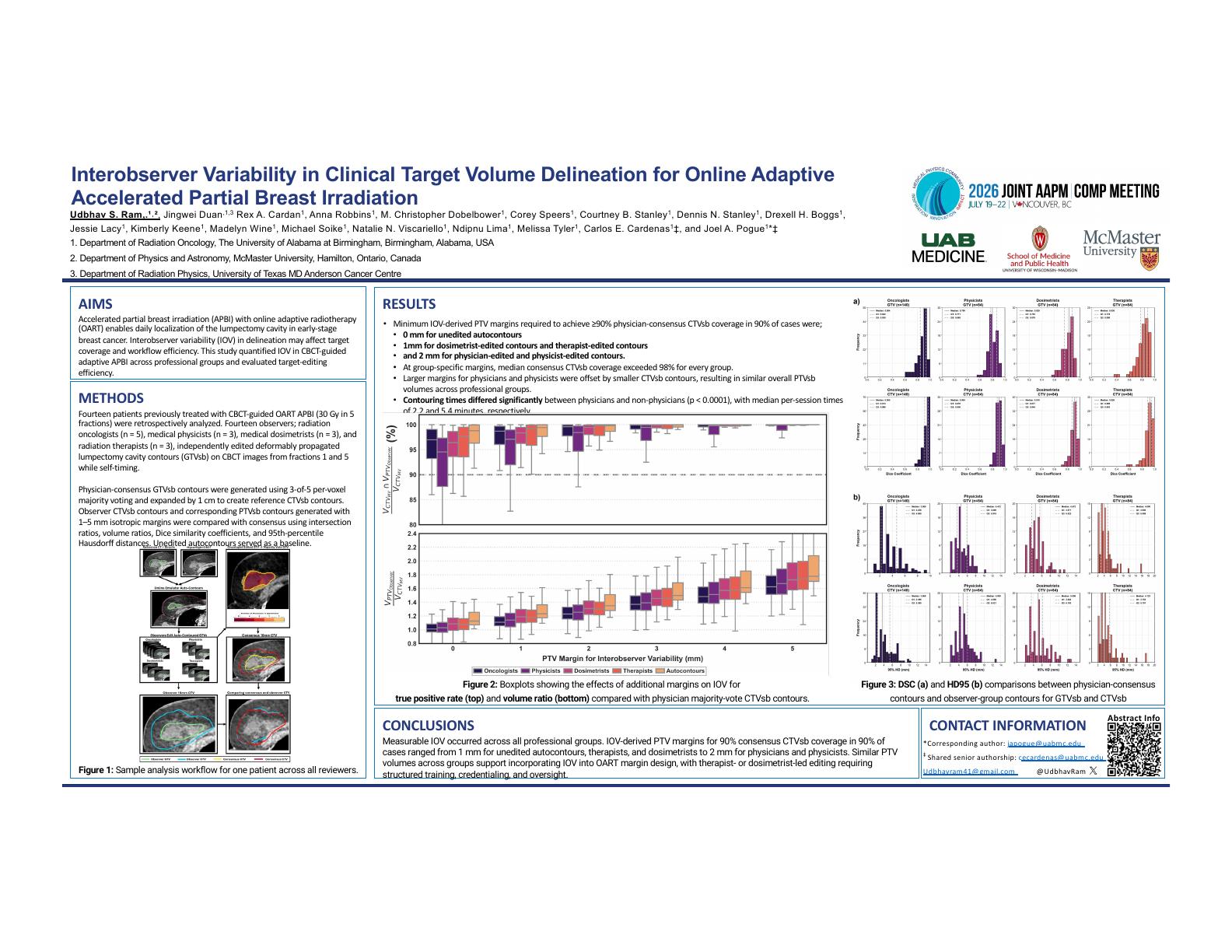
In this retrospective, single-institution study, 14 observers reviewed 14 patients: five radiation oncologists, three physicists, three dosimetrists, and three therapists. Observers edited propagated lumpectomy-cavity contours on treatment fractions 1 and 5.
The analysis compared the resulting coverage and treated volume at margins from 1 to 5 mm, using majority-vote physician contours as the reference. Small margins substantially improved overlap; median coverage of the physician-consensus reference approached 100% around 3 mm across groups.
The finding is a coverage–volume tradeoff, not a universal margin prescription. Physician consensus is a practical reference rather than known biological ground truth, and the retrospective single-institution design limits generalization.
Where it fits in my work
This project grew from my medical-physics and radiation-oncology research at UAB. It continues a broader thread in my work: evaluating computational tools in the context of the people who have to use them.
My related projects compare physician assessments of automatically generated contours, evaluate planning configurations, and explore how clinical information can be carried more clearly from one stage of care to another.
Latest public record
As first author and presenter, I shared this work at the 2026 American Society for Radiation Oncology (ASTRO) Annual Meeting in Boston on September 29, 2026. The official program lists it as poster 3104.
The conference presentation is the current public record linked here. A separate full journal article is not listed as published on this page.
Sources & further reading
Research summary updated October 5, 2026. Findings describe the linked study and do not establish clinical readiness beyond its evaluation.