Watch the study.
Preview images load from this site. YouTube connects only after you press play.
LLM based target name adherence in radiation oncology
A short research presentation on language-model-assisted target-name adherence in radiation oncology.
Uploaded September 9, 2025
Why naming matters
Radiation-oncology teams work with treatment targets and organs that need consistent, interpretable labels. The American Association of Physicists in Medicine (AAPM) Task Group 263 provides a standard nomenclature, but real clinical names can still vary widely.
The research question was whether locally hosted large language models could help bring clinical target names into that convention without relying on an external model service.
The approach
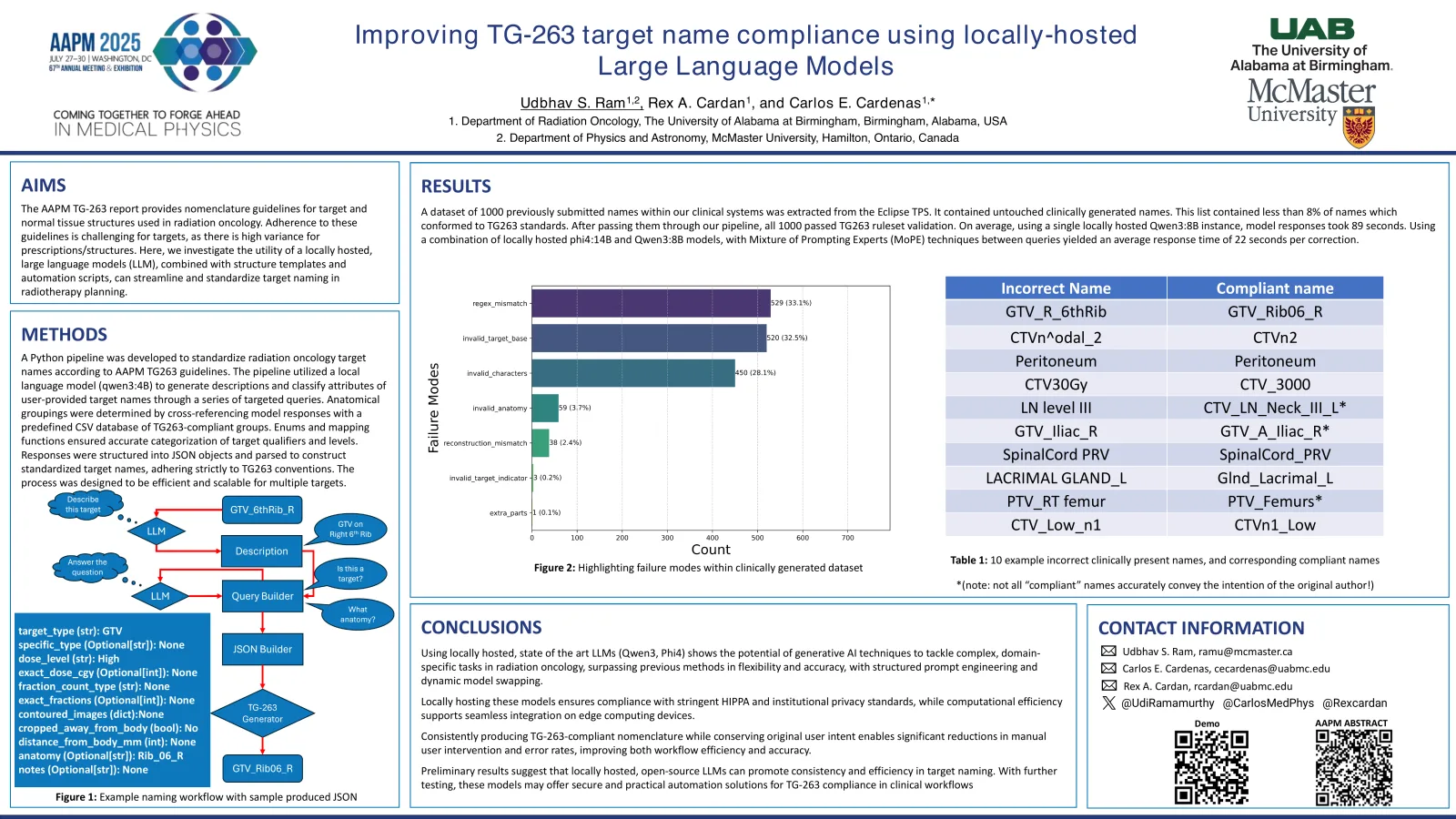
The pipeline combined structured prompting, a naming ruleset, and language-model processing. It compared a Qwen3:8B workflow with a Phi4:14B / Qwen3:8B mixture-of-prompting-experts approach. It evaluated 1,000 clinical names and used explicit rule checks to assess whether each output followed the TG-263 naming requirements.
Locally hosted models make deployment location an explicit part of the design. This is distinct from demonstrating the privacy, reliability, or readiness of a complete clinical product.
The result, and the important caveat
All evaluated outputs passed the implemented TG-263 ruleset after correction. Reported mean response time decreased from 89 to 22 seconds. The poster also documents examples in which a corrected name changed the author’s intended meaning.
Syntactic compliance and semantic correctness are different outcomes. A technically valid name is not necessarily the right clinical name. The result supports a reviewed quality-assurance workflow, with clinical interpretation kept in the loop.
Sharing the work
The study received a Blue Ribbon Poster designation at the AAPM 2025 Annual Meeting. The full poster provides the methods, examples, and limitations behind the summary.
Sources & further reading
Research summary updated October 5, 2026. Findings describe the linked study and do not establish clinical readiness beyond its evaluation.