Watch the study.
Preview images load from this site. YouTube connects only after you press play.
Dosimetric Comparison of 6X/10X flattening filter free beams at the Juravinski Cancer Centre
The final thesis presentation comparing 6X and 10X flattening-filter-free beams at Juravinski Cancer Centre.
Uploaded April 17, 2025
Event: April 16, 2025
The question
Stereotactic body radiotherapy (SBRT) delivers highly focused treatment outside the brain. For lung targets, the surrounding anatomy and the target’s location can influence which beam characteristics are useful.
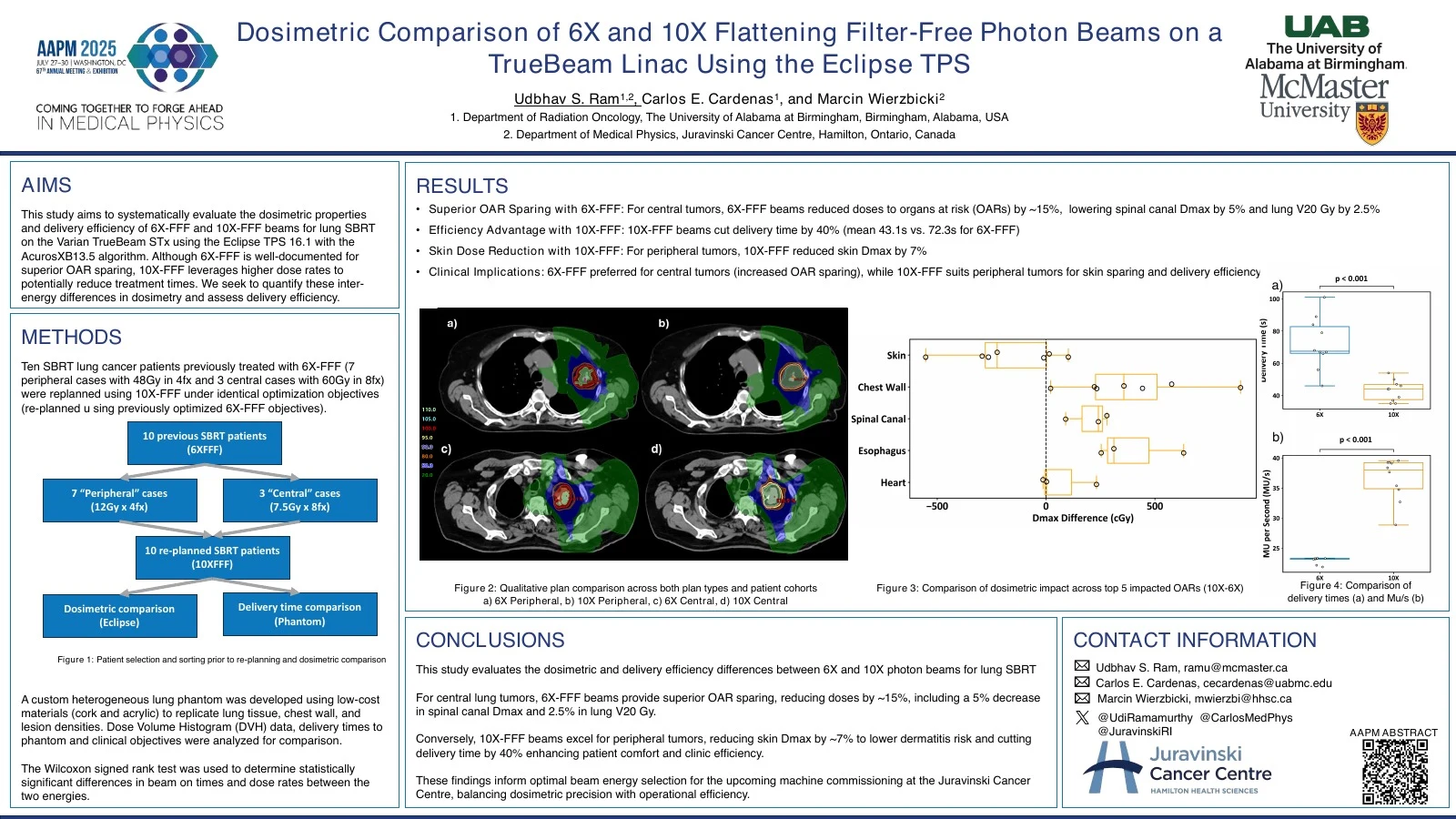
This work compared 6X-FFF and 10X-FFF beams, two flattening-filter-free photon-beam options, in Eclipse treatment planning and delivery measurements.
From plan to phantom
The evaluation included a custom heterogeneous lung phantom made from cork and acrylic. A phantom allows a physical measurement to complement the computer-generated dose plan.
The work was presented as a first-author AAPM 2025 poster with Carlos E. Cardenas and Marcin Wierzbicki.
What the comparison showed
The reported central-tumour organ-at-risk sparing favored 6X-FFF. Peripheral skin-dose and delivery-time measures favored 10X-FFF; mean delivery times were 72.3 and 43.1 seconds, respectively.
These are configuration-dependent planning and phantom findings. They do not establish one universally preferable beam energy or demonstrate a patient-outcome benefit.
Sources & further reading
Research summary updated October 5, 2026. Findings describe the linked study and do not establish clinical readiness beyond its evaluation.