Watch the study.
Preview images load from this site. YouTube connects only after you press play.
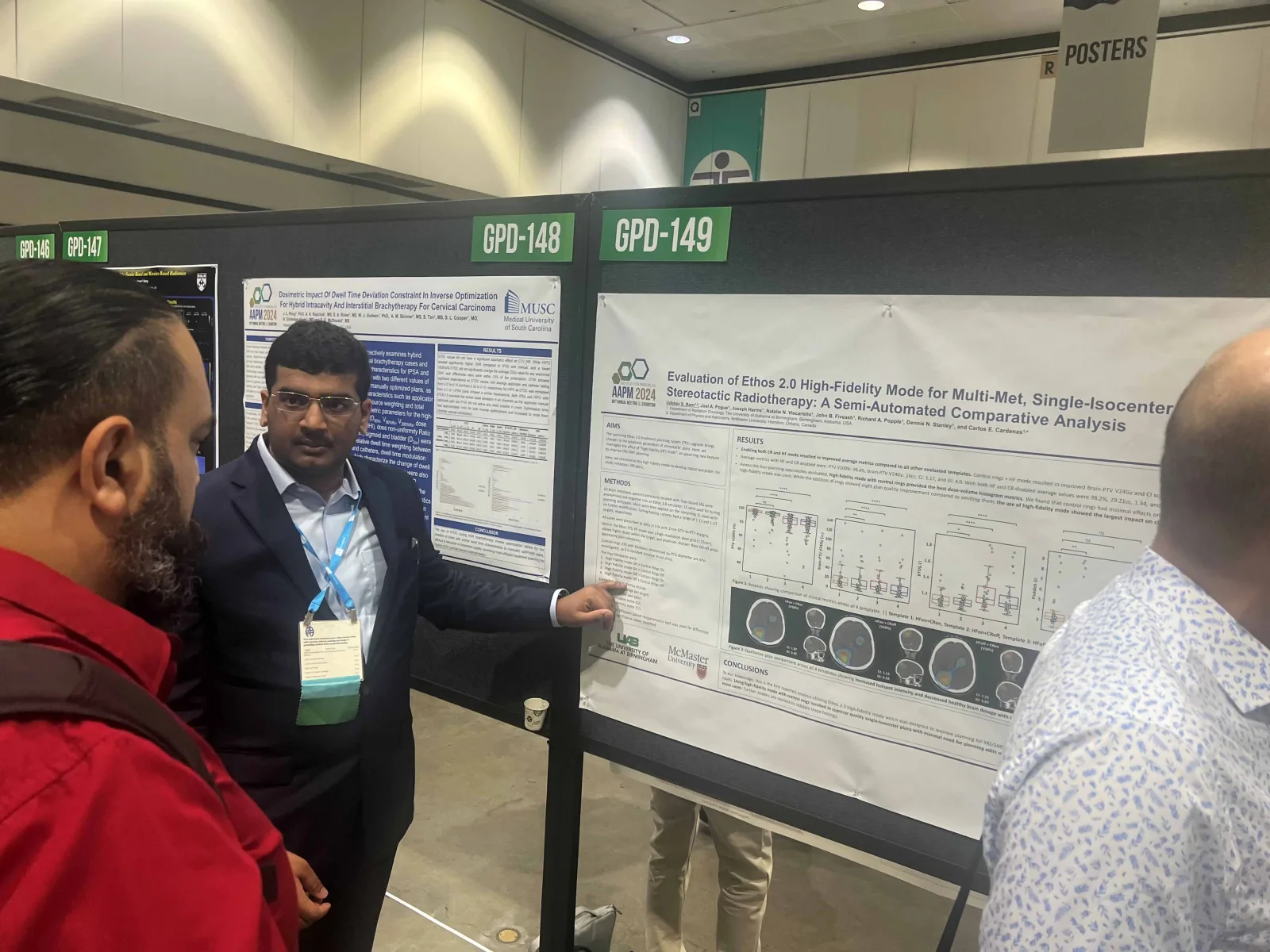
Udbhav Ram SPScon 2025 Invited Poster
A recorded overview of the invited SPSCon poster on Ethos 2.0 high-fidelity radiosurgery planning.
Uploaded October 7, 2025
The planning question
Stereotactic radiosurgery (SRS) delivers focused radiation to small targets. A single-isocenter approach treats multiple metastases around one common planning center, making the dose distribution around each target especially important.
This study compared four Ethos planning configurations to separate the effects of high-fidelity mode and control rings, rather than treating a planning system as a single fixed intervention.
Study design
The study included 45 patients: 15 used for tuning and 30 for validation. Plans were evaluated for target conformity, dose falloff, normal-tissue exposure, and complexity.
Plans were generated in a non-clinical emulator with 30 Gy delivered in five fractions and a 2 mm planning-target-volume margin. Using a separate validation group tested the configuration beyond the tuning cases.
I co-designed the study, tuned and evaluated the templates, assembled the results, and wrote the manuscript, as documented in the published author-contributions statement.
What changed
High-fidelity mode combined with control rings improved conformity and dose falloff, reduced normal-tissue dose, and lowered plan complexity in this evaluation.
The finding is about treatment-plan configuration and dosimetric performance. It does not establish improved survival, reduced clinical toxicity, or the outcome of a clinical trial.
Only the high-fidelity-plus-rings template was tuned before the other variants were created. That creates possible template-calibration bias: the comparison does not establish the best achievable performance of independently optimized alternatives.
Publication and presentations
The final peer-reviewed article appeared in the Journal of Applied Clinical Medical Physics in 2025. Earlier conference presentations used a longer project title; the title here matches the published paper.
Sources & further reading
Research summary updated October 5, 2026. Findings describe the linked study and do not establish clinical readiness beyond its evaluation.